
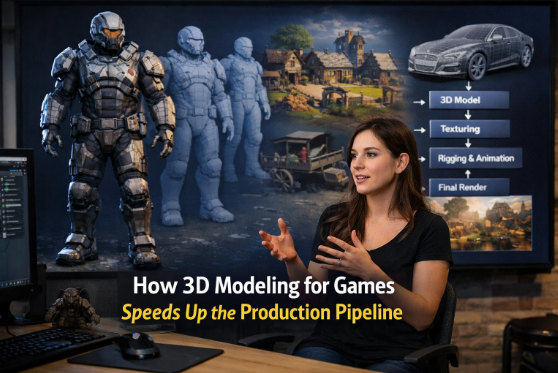
Life moves fast today in game development. Game studios create worlds that visually outshine the competition, deliver seamless gameplay, and improve games from time to time within very narrow timeframes. In this context, 3D modeling for games has become one of the most essential factors for speeding up production while maintaining quality.
Once models are conceived, created, and optimized properly, they eliminate redoing parts of a project, facilitate collaboration, and keep every stage of development moving forward. Work is made all the more efficient and predictable for studios working with a reputable 3D visualization company.
Faster Concept-to-Asset Translation
One of the worst bottlenecks in game production occurs when ideas are left too long in the abstract. Clear 3D models are generated solely from concept art. 3D modeling for games allows a designer to translate sketches and references into physical assets that programmers and level designers can immediately realize.
This clarity eliminates the confusion behind back-and-forth revisions and helps the teams align well early in the pipeline. When everyone’s looking at the same three-dimensional asset, decisions are made faster and more confidently.
Reusable Asset Libraries Save Time
Modern game development relies heavily on asset reuse, especially for props, environments, and background elements.
With good 3D modeling for games, studios can create libraries of reusable assets to plug and adapt through multiple levels or perhaps for future projects, creating instead of every object from scratch, a team that modifies already existing models, models-the saving has gone up into countless hours.
This improved cycle not only hastens the whole production process but also ensures a visual consistency throughout the entire world outside, thus further minimizing the polishing time later on.
Smoother Collaboration Between Teams
Creating a video game involves collaboration with artists, programmers, animators, and designers. Unsatisfactory reheated assets will slow down the whole process, and well-ordered ones will smoothly integrate into engines and animation pipelines via their correct naming when modeling topology.
This would keep all 3D modeling production-friendly standards when games were modeled. With that standard, department handoffs become seamless, where programmers need not fix broken meshes, animators won’t struggle with rigging issues, and designers will focus more on gameplay rather than troubleshooting assets.
Early Optimisation Prevents Late-Stage Rework
Leaving optimization to be done in the final stages of game development remains one of the most damaging mistakes that can happen. Heavy models that remain unoptimized compel people to rework assets under much pressure. Efficient 3D modeling for games also sets prospective polycount, UV layout, and texture use from the very beginning.
Thus, production teams would not have to deal with the last-minute crunch when things go wrong and surprise performance issues. The proactive approach saves all the time allocated for testing, QA, and platform optimization, in particular when targeting several devices.
Faster Iteration and Testing Cycles
All the assets undergo excessive iterations during the game development process, brought about by different gameplay tests, feedback from users, and the creative direction of the game. Clean 3D models make iteration faster because changes can be applied without breaking the asset or affecting other systems.
Scaling an object or tweaking its proportions to make it just right, efficient 3D modeling for games allows teams to test changes quickly and move forward. Less bottlenecking means a more agile production cycle.
Improved Integration With Game Engines
Modern engines like Unreal and Unity will reward assets well prepared. Models with the correct numbers of scale, proper orientations, and materials are imported cleanly and act predictably. This means fewer technical problems and precious time saved from devising fixes for avoidable challenges.
When 3D modeling for games meets the engine requirements, assets can drop right into scenes and work as intended. A professional 3D visualization company has this technical expectation in mind and builds models intended for smooth integration, keeping development on schedule.
Consistent Quality Reduces Polishing Time
Extra work can be created if there is an inconsistency in asset quality. Some assets have to go under heavy refinements, while others are pretty much game-ready. Consistent good 3D modeling for games builds a uniform level of quality from the start for characters, props, and environments.
This uniformity, in turn, reduces the need for heavy visual corrections near the end of development. With this minor correction made, teams can now use more time during this critical juncture to refine the game further and enhance the user experience.
Better Planning Leads to Predictable Timelines
When asset creation is efficient and organized, timelines for production can be made far more predictable. That would enable teams to predict workloads more accurately, allocate resources better, and prevent those sudden delays.
Keeping assets moving in sync with the delivery of the asset enables a milestone to be met successfully without missing any deadlines, invaluable for studios operating in a publisher- or investor-based model.
Conclusion
Speed in the game development process does not mean rushing things. It’s about eliminating friction at every stage of the pipeline. Through thoughtful 3D modeling for games, one can speed up production, affording clarity, reuse, collaboration, and optimization right from day one.
When studios engage a competent 3D visualization provider, they acquire production-ready assets that are visually impressive in addition to bringing faster development and fewer hurdles into a much smoother road from the concept stage to launch.